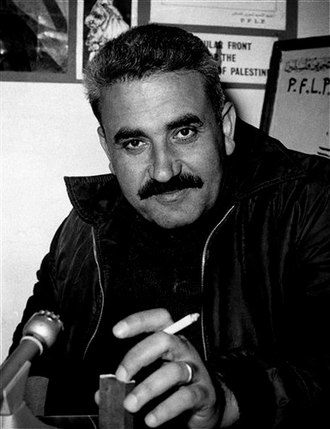
George Habash
Category : HorrorDocs , PoliticianDocs
George Habash (Arabic: جورج حبش), also known by his laqab “al-Hakim” (Arabic: الحكيم, “the wise one” or “the doctor”; 2 August 1926 – 26 January 2008) was a Palestinian Christian politician who founded the Marxist–LeninistPopular Front for the Liberation of Palestine (PFLP). Habash served as General Secretary of the PFLP until 2000, when ill health forced him to resign.[1][2][3]
Habash was born in Lydda (today’s Lod) to an Eastern Orthodox Palestinian family in 1926.[4][5] As a child, he sang in the church choir.[6] Habash, a medical student at the American University of Beirut, was visiting his family during the 1948 Arab–Israeli war. In July 1948, the Israeli Defence Force captured Lydda from Jordanian and Arab Liberation Army forces, resulting in all of the town’s Arab residents leaving and the death of Habash’s sister. Habash and his remaining family became refugees and were not allowed to return home.
Political thinkers who were influences on Habash at this period included Constantin Zureiq, whose lectures at AUB on ‘Arab nationalism and the Zionist danger’ in the late 1940s and early 1950s Habash had attended, and Sati’ al-Husri an Arab Muslim intellectual who emphasized national cohesiveness, territorial patriotism, and loyalty to the state, and gave priority to Arab unity over Islamic unity.[7]
In 1951, after graduating first in his class from medical school, Habash worked in refugee camps in Jordan and ran a clinic with Wadie Haddad in Amman. He firmly believed that the state of Israel should be ended by all possible means, including political violence.[8] In an effort to recruit the Arab world to this cause, Habash founded the Arab Nationalist Movement (ANM) in 1951 and aligned the organization with Gamal Abdel Nasser‘s Arab nationalist ideology.
He was implicated in the 1957 coup attempt in Jordan, which had originated among Palestinian members of the National Guard. Habash was convicted in absentia, after having gone underground when Hussein of Jordan proclaimed martial law and banned all political parties. In 1958 he fled to Syria (then part of the United Arab Republic), but was forced to return to Beirut in 1961 by the tumultuous breakup of the UAR.
Habash was a leading member of the Palestine Liberation Organization until 1967 when he was sidelined by Fatah leader Yasser Arafat, with whom he had a complex relationship described as a mix of “camaraderie and rivalry” and “a love-hate relationship”.[9][10] In response, Habash founded the Popular Front for the Liberation of Palestine.
web
wikipedia DE – wikipedia EN – wikipedia XY
youtube – vimeo – soundcloud
facebook – twitter – instagram – XING
work

