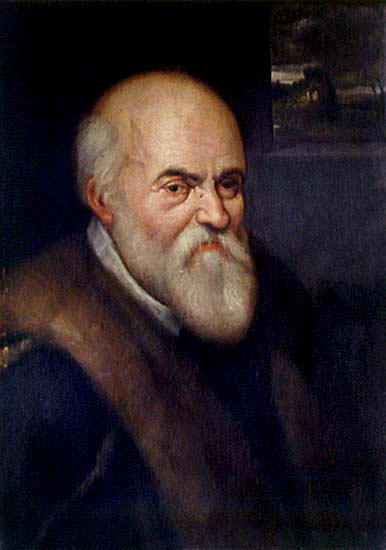
Ulisse Aldrovandi
Category : AdvocateDocs , biologyDocs , BotanicDocs , managerDocs , philosophyDocs
Ulisse Aldrovandi (11 September 1522 – 4 May 1605) was an Italian naturalist, the moving force behind Bologna’s botanical garden, one of the first in Europe. Carl Linnaeus and the comte de Buffon reckoned him the father of natural history studies. He is usually referred to, especially in older scientific literature in Latin, as Aldrovandus; his name in Italian is equally given as Aldroandi.
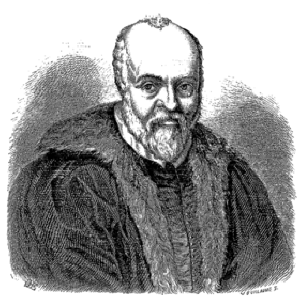
Aldrovandi was born in Bologna to Teseo Aldrovandi and his wife, a noble but poor family. His father was a lawyer, and Secretary to the Senate of Bologna, but died when Ulisse was seven years old. His widowed mother wanted him to become a jurist. Initially he was sent to apprentice with merchants as a scribe for a short time when he was 14 years old, but after studying mathematics, Latin, law, and philosophy, initially at the University of Bologna, and then at the University of Padua in 1545, he became a notary. His interests successively extended to philosophy and logic, which he combined with the study of medicine.[1]
In June 1549, Aldrovandi was accused and arrested for heresy on account of his espousing of the anti-trinitarian beliefs of the Anabaptist Camillo Renato. By September, he publicly abjured, but was nevertheless transferred to Rome, and remained in custody or house arrest until absolved in April, 1550. During this time, he befriended many local scholars. While in light captivity there, he became more and more interested in botany, zoology, and geology (he is credited for the invention/first written record of this word[2]). From 1551 onward, he organized a variety of expeditions to the Italian mountains, countryside, islands, and coasts to collect and catalogue plants.
He obtained a degree in medicine and philosophy in 1553 and started teaching logic and philosophy in 1554 at the University of Bologna. In 1559, he became professor of philosophy and in 1561 he became the first professor of natural sciences at Bologna (lectura philosophiae naturalis ordinaria de fossilibus, plantis et animalibus).[1] Aldrovandi was a friend of Francesco de’ Medici, Grand Duke of Tuscany (1574 – 1587), visiting his garden at Pratolino and travelling with him, compiling a list of the most valuable plants at Pratolino.[b] He also formed fruitful associations with botanical artists such as Jacopo Ligozzi, to further develop illustrated texts.[3] He died in Bologna on 4 May 1605, at the age of 82.
Aldrovandi’s wife Francesca Fontana was invaluable to his research. He utilized her dowry to build their massive country estate that ultimately included his natural history collection. She was a research partner who located texts for him to cite and use in his books, edited his books, and wrote sections of them as well. She wrote the preface for his posthumous book On the Remains of Bloodless Animals, which Suzanne Le-May Sheffield described as “their shared work”.[4]
Over the course of his life, he would assemble one of the most spectacular cabinets of curiosities: his “theatre” illuminating natural history comprising some 7000 specimens of the diversità di cose naturali, of which he wrote a description in 1595. Between 1551 and 1554, he organized several expeditions to collect plants for a herbarium, among the first botanizing expeditions. Eventually, his herbarium contained about 4760 dried specimens on 4117 sheets in sixteen volumes, preserved at the University of Bologna. He also had various artists including Jacopo Ligozzi, Giovanni Neri, and Cornelio Schwindt, compose illustrations of specimens.
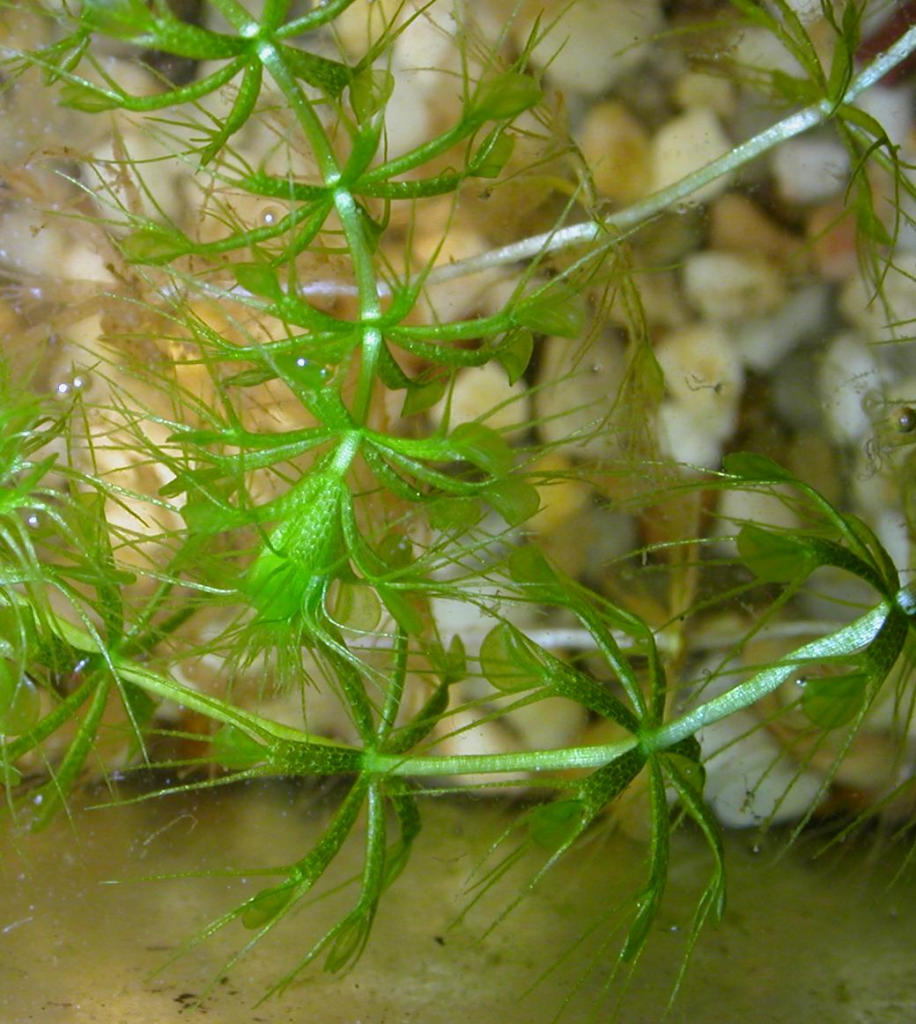
At his demand and under his direction, a public botanic garden was created in Bologna in 1568, now the Orto Botanico dell’Università di Bologna.[5] Due to a dispute on the composition of a popular medicine with the pharmacists and doctors of Bologna in 1575, he was suspended from all public positions for five years. In 1577, he sought the aid of Pope Gregory XIII (a cousin of his mother), who wrote to the authorities of Bologna to reinstate Aldrovandi in his public offices and request financial aid to help him publish his books.

The Civico Orto Botanico “Ulisse Aldrovandi” in San Giovanni in Persiceto is named in his honor.